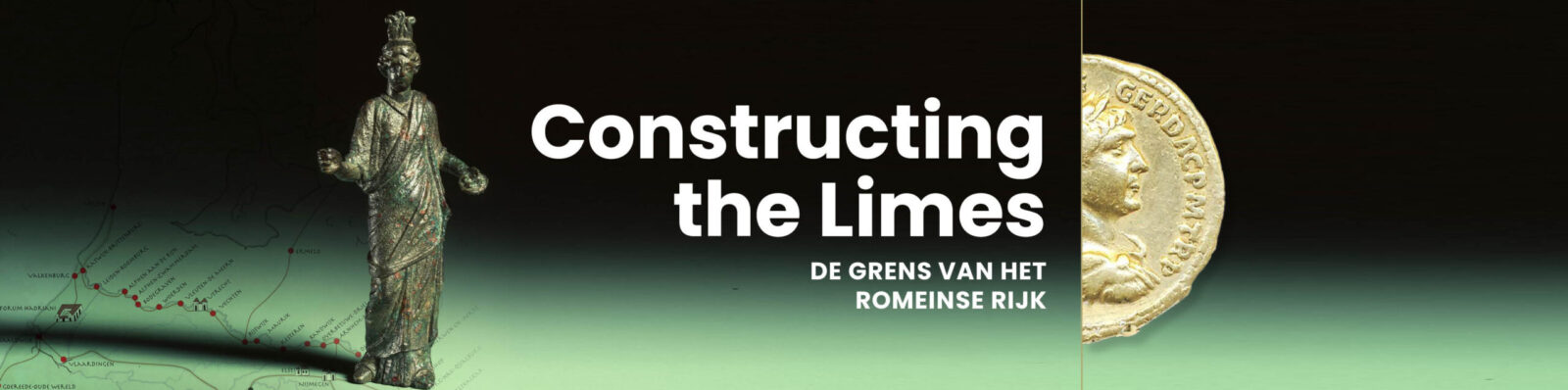

What do you picture when you think of the Romans? Perhaps white men from Rome who were always fighting. Or an impenetrable frontier lined with walls, watchtowers and soldiers. After all, that is what the pictures in school textbooks looked like. But is that image accurate? That is what the Constructing the Limes team is investigating. Using new techniques and ways of looking at the past, they are discovering that history is often more complex than we have long assumed.
The exhibition aims to introduce visitors to this new knowledge. Some of these insights may already have been known within academia for some time or may build on existing ideas, but have barely reached a wider audience. That is precisely why it is valuable to bring five years of research beyond the academic world and make it accessible to the public.
How we look at history is determined not only by the knowledge we have, but also by the time in which we live. And by who tells us the story. Look at the past from a different perspective, and it can look very different.
That is why the researchers at Constructing the Limes each have their own area of expertise, from archaeology to politics and from geology to art history. They are supported by amateur archaeologists: enthusiastic volunteers with extensive knowledge and experience. Together, they are building as complete a picture as possible of life around the Roman frontier in the Netherlands.
In Different than expected, we highlight nine striking new insights. You will see, for example, what can happen when old finds are examined using new techniques. How an unremarkable fragment can sometimes tell a much bigger story. And how politicians today consciously use a particular image of the Romans to convince people that they are right.
But beware: the story we tell is not set in stone either. Research and our understanding of the past are constantly evolving. That is why we invite you to remain curious and look at the past with a critical eye. Who knows what hidden stories are still waiting to be discovered?
Would you like to contribute your finds to scientific research?
Your finds can contribute to scientific research. By reporting them to Portable Antiquities of the Netherlands (PAN), they are recorded in a public database. This allows researchers, museums, heritage enthusiasts and others to use the information to learn more about the past. But it works both ways: by reporting your find, you can also learn more about it yourself. PAN’s find registrars can help answer questions about your find.
Together, we know more
Within Constructing the Limes, collaboration with PAN and metal-detectorists has grown into an important part of the research project over the past few years. During several PAN events, researchers and detectorists shared their knowledge and finds with one another. This created a valuable exchange: detectorists contributed new finds and information, while researchers helped place these finds within a broader historical context.
A good example is the research by PhD researcher Arjan Ruiter into early Roman fibulae (brooches). To investigate the distribution, metal composition and origins of different types of fibulae, he approached metal-detectorists whose finds had been registered with PAN. In total, 130 fibulae were examined using a portable XRF scanner, which made it possible to determine their metal composition. Among other things, the research showed a shift over time from bronze to brass. Lead isotope analysis also provided clues about the origin of the raw materials, including zinc ore from northern Italy and, for some fibulae, from the area around Aachen.
This research shows what becomes possible when finds and knowledge are shared. Finds made by metal-detectorists provide new information for scientific research, while researchers can in turn offer greater insight into the age, composition, origin and significance of a find.
By reporting a find, you are therefore not only contributing to scientific research, but also gaining a better understanding of your own find.
Ready to get started?
Would you like to know how to report a find and what happens afterwards? Check out the Portable Antiquities of the Netherlands website.
Would you like to learn more about metal detecting and exchange experiences with other detectorists?
Visit the Detector Amateur Association (DDA)
Explore the topics in more depth
In the exhibition, you encountered various topics from the research carried out by Constructing the Limes. Would you like to learn more about one of these subjects or explore it in greater depth? Explore the different themes below.
This might be interesting for you:
- ‘The Relevance of Sr–O–C Isotope Analysis on Burnt Human Skeletal Remains in Archeological and Forensic Contexts’ door Maura De Coster, Saskia Ammer, Tim Laning en Lisette Kootker
- Maura De Coster haalt subsidie binnen voor isotopen- en DNA onderzoek op de ‘Loden Lady’
- ‘The Roman Military Community as a Melting Pot: Biomolecular Evidence from the Lower Rhine Limes’ door Maura De Coster, Fabricio Furni, Wouter K. Vos, Jeroen Oosterbaan, Gareth R. Davies en Lisette M. Kootker
This might be interesting for you:
- ‘Global tastes, local choices: Strontium isotope and concentration evidence for changing dietary input in Roman Nijmegen, the Netherlands’ door Maura De Coster, Joep Hendriks, Hannah F. James, Christophe Snoeck, Gareth R. Davies en Lisette M. Kootker
- ‘Towards an archeological workflow for sedaDNA sample collection’ door Kadir Toykan Özdoğan, Fabricio Furni, Ivo Laros, Gertjan Plets en Arjen de Groot
- ‘Archaeology meets Environmental Genomics: implementing sedaDNA in the study of the human past’ door Kadir Toykan Özdoğan, Arjen de Groot, Gertjan Plets
This might be interesting for you:
- ‘We are all borderworkers’ door Paschalina Garidou, Luuk Winkelmolen, Henk van Houtum
- ‘Waiting for Today’s Barbarians: How the Fall of the Roman Empire Is Anachronistically Exploited to Serve a Contemporary Discriminatory B/Ordering and Othering Agenda’ door Luuk Winkelmolen, Paschalina Garidou, Henk van Houtum
This might be interesting for you:
About the collaboration
Not as Expected: Romans in the Netherlands is the result of five years of research within Constructing the Limes (C-Limes). Researchers from various disciplines, amateur archaeologists, and the Valkhof Museum worked together to make new insights into the Roman period in the Netherlands accessible to a broad audience.
The exhibition was developed through C-Limes, affiliated with Utrecht University, with funding from NWO and the Dutch National Research Agenda (NWA), in collaboration with the Valkhof Museum. Studio Louter was responsible for the concept development, and Opera Amsterdam for the exhibition design. We would also like to extend our sincere thanks to all the lenders.