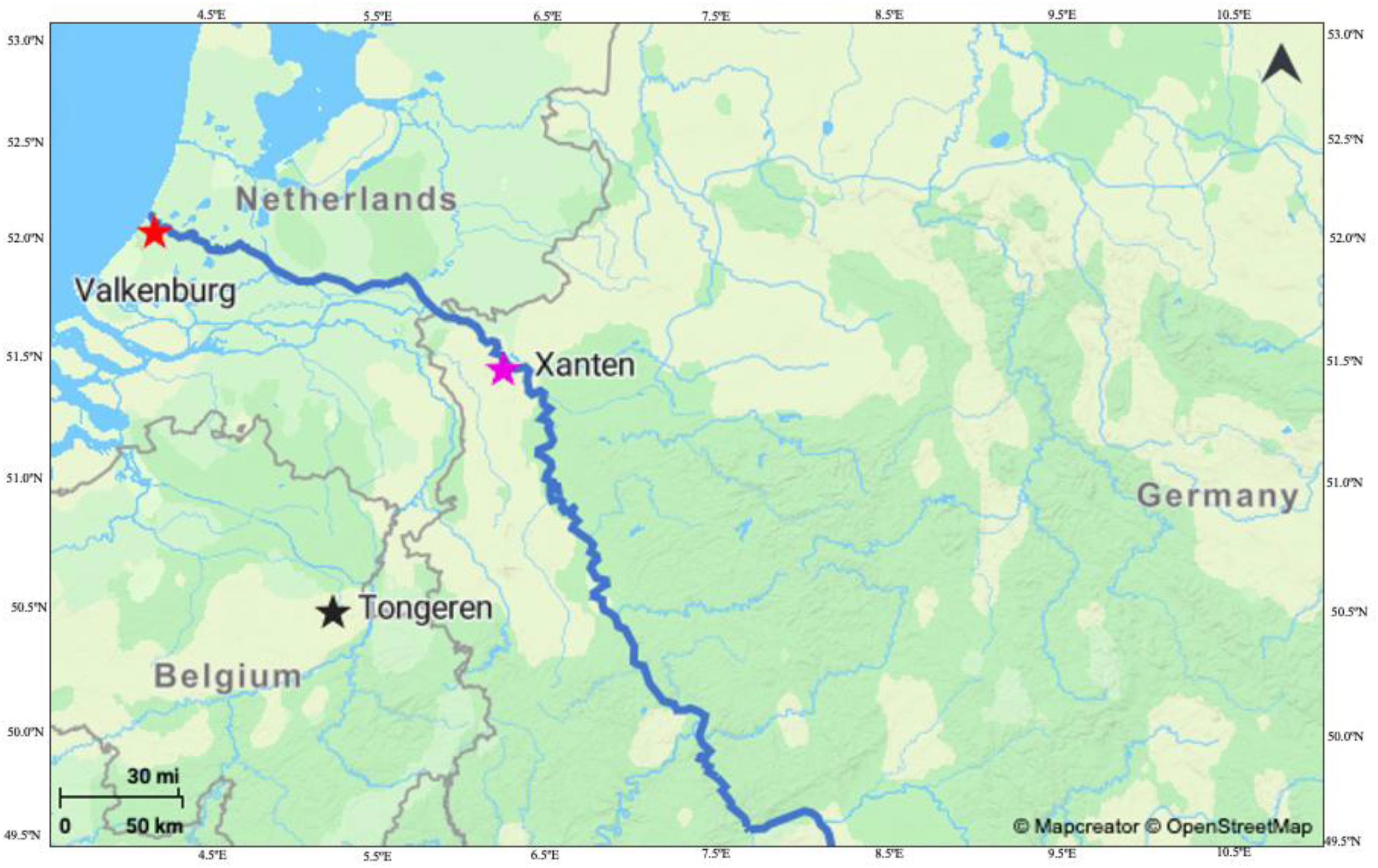
‘Stable carbon and nitrogen isotope dataset from Roman sites in Germania inferior (Xanten, Tongeren, and Valkenburg)’ door Anna Żmudzka, Maura De Coster, Wouter Vos, Henk van der Velde, Bernd Liesen, Jason E. Laffoon en Lisette M. Kootker
Titel: Stable carbon and nitrogen isotope dataset from Roman sites in Germania inferior (Xanten, Tongeren, and Valkenburg)
Auteurs: Anna Żmudzka, Maura De Coster, Wouter Vos, Henk van der Velde, Bernd Liesen, Jason E. Laffoon en Lisette M. Kootker
Publicatiejaar: 2026
Publicatietype: artikel
Samenvatting
This dataset includes stable carbon (δ¹³C) and nitrogen (δ¹⁵N) isotope measurements from bone and dentine collagen of 38 human and 10 faunal samples dated to the 1st to 4th centuries CE. The material derived from three Roman sites in Germania Inferior that were located along the northwestern frontier of the Roman Empire, the limes, and Via Belgica respectively: Xanten (Colonia Ulpia Traiana) in Germany and Valkenburg-Marktveld (Praetorium Agrippinae) in the Netherlands, and Tongeren (Atuatuca Tungrorum) in Belgium. All analyses were performed using a Thermo DELTA™ Q Isotope Ratio Mass Spectrometer, coupled with a Flash elemental analyser. The isotopic data of the collagen samples are presented in δ notation (‰) normalized to the international standard VPDB (Vienna Peedee Belemnite) and atmospheric nitrogen (air) for carbon and nitrogen respectively. The acquired dataset provides a reference for isotopic studies of diet and subsistence in Roman frontier populations and is suitable for reuse in research on dietary reconstruction and for cross-site comparisons. This data article summarises the obtained carbon and nitrogen isotope data, which are deposited in the open access IsoArcH repository (www.isoarch.org) for future studies.